At TEDMED 2014, Founder and CEO of Theranos, Elizabeth Holmes, talked about the importance of enabling early detection of disease through new diagnostic tools and empowering individuals to make educated decisions about their healthcare.
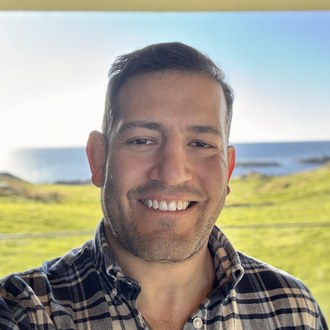
At TEDMED 2014, Founder and CEO of Theranos, Elizabeth Holmes, talked about the importance of enabling early detection of disease through new diagnostic tools and empowering individuals to make educated decisions about their healthcare.
An interesting piece on the woman behind Theranos, a blood testing company which intends to disrupt the medical blood sampling industry.
I’m bullish about the company, but don’t share their belief that everyone will suddenly submit themselves to testing out of conveniency. Most people wish to stay blissfully ignorant. That being said, a large enough portion of the populace will use Theranos’ test-kits so that the medical establishment will need to reevaluate the way blood sampling is used in diagnosis and therapy of these subgroups.
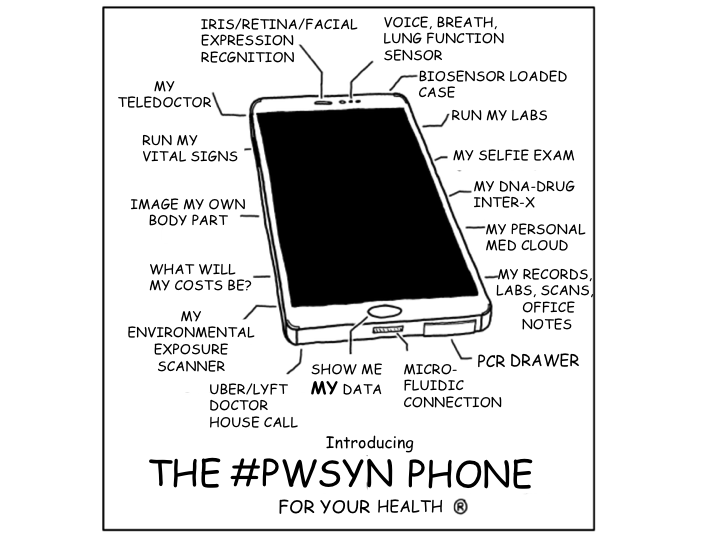
The future medical smartphone as envisioned by xkcd.
When they work, it’s great. The $200 Microsoft Band has given me a deeper look at my intense spinning workouts, which can’t be measured in steps, and the $200 Basis Peak has even calculated my resting heart rate fairly accurately after weeks of wear (confirmed by Dr. Osher to be about 60 beats per minute).
The problem is the results from the wrist are highly erratic, especially when moving.
As I stood stationary on a treadmill in Dr. Osher’s office with EKG-connected electrodes stuck to my chest, she said my heart rate was 72. The Microsoft Band said the same, and the Basis Peak also started out in sync.
But when the treadmill started up and began to incline, the bands had a harder time keeping up than I did. When the EKG said I was at 130, the Basis said 115 and the Microsoft 100.
Unsurprisingly, chest-worn heart rate monitors were accurate during activity. I guess wrist-worn heart rate monitors are still sales gimmicks.
“Our vision at Samsung is to empower people, to improve their lives through our digital health platform,” Samsung Chief Medical Officer and VP for Global Healthcare David Rhew said from the keynote stage at the mHealth Summit in National Harbor, Maryland. “We know that, while we can do a significant amount in this area, we can’t do it alone. That’s really why we’re here at mHealth. We’re counting on developers, mHealth companies, other key stakeholders, to help us create an open ecosystem so we can develop, test, validate these solutions and ultimately improve health outcomes through patient engagement.”
Samsung isn’t known for producing high quality software or user experiences. Their heart rate sensors on the Galaxy phone and smartwatch lines are a joke. I don’t see S Health making any real impact.
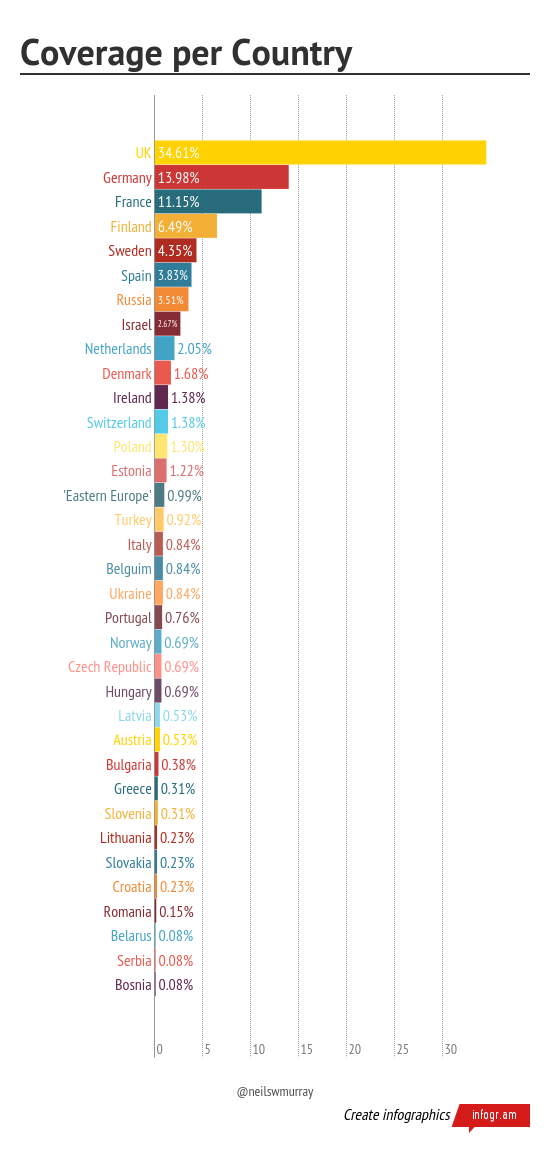
It seems that Finland and Sweden are the countries getting most of the news coverage. I believe we’ll see Norway climbing the chart in the comming years.
Ifølge Peter Huntley ligger hovedproblemet i den incitamentsstrukturen i finansieringssystemet, hvor betalingen fra staten til dem, der leverer ydelserne, finder sted. Denne struktur er ikke gearet til innovation og telemedicin, og der er i øjeblikket ikke tilstrækkelige økonomiske argumenter for, at man skal skifte over til telemedicin, hævdede Peter Huntley. I den forlængelse nævnte han en “what’s in it for me”-kultur, hvor hospitaler og læger spørger sig selv, hvad de får ud af det. Vil de praktiserende lægers antal patienter dale i takt med indførelsen af telemedicin, og hvor skal hospitalerne få pengene fra, hvis patienter kun er indlagt i to dage i stedet for fire?
Stort set de samme forhold gør sig gældende i Norge.
Lungeavdelingen på UNN har nemlig skrevet ut sin første pasient med et nettbrett i bagasjen. Sammen med nettbrettet følger et oksymeter. Med dette kan pasienten måle oksygennivået i blodet. Pasienten fyller ut et spørreskjema som dokumenterer han eller hennes tilstand. Ved hjelp av en webapplikasjon på nettbrettet kan pasienten sende denne informasjonen til lungeavdelingen på en sikker måte og ha videomøter med sykepleierne. På lungeavdelingen har de opprettet en telemedisinsk sentral som brukes til dette.
“Nytænkende” kan man vidst ikke længere kalde det - se bl.a. her og her.
While you might not see a flood of prescription-only apps hit the app store in January — launching one requires FDA approval, clinical trials, insurance reimbursement and more — WellDoc’s co-founder and chief medical officer Dr. Suzanne Sysko Clough says we should “expect to see more Mobile Prescription Therapies for many major chronic diseases over the coming years.”
Prescription-apps are going to be a major deal in 2015 and onwards.
Some clinics are being redesigned to encourage patients, especially reclusive teenagers, to be more social. The infusion clinic at Cook Children’s Medical Center in Fort Worth, Tex., now includes play areas for younger children and long tables for teenagers to do their homework and watch TV together.
Some times making a big difference takes a minor effort.
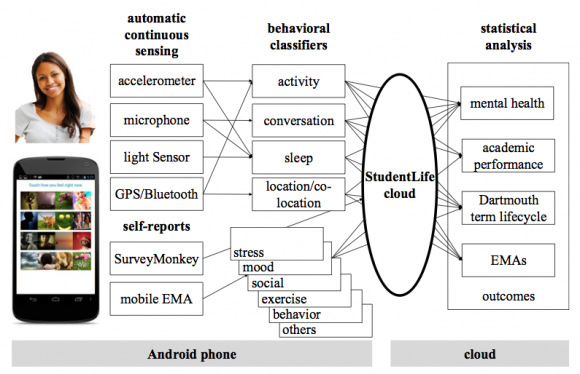
A student study gives an idea of what factors are possible to follow with an (Android) smartphone. Most “free” commercial apps on Android presumably already track these data on their users for monetization reasons.
CONCLUSIONS: The Fitbit One activity monitors are valid and reliable devices for measuring step counts in healthy young adults. The distance output of the monitors is inaccurate and should be noted with caution.
Granted the study is small, but the results aren’t uplifting. Still, in healthy adults the Fitbit One activity tracker can be used for measuring steps - but not distance as it kept overestimating the distance traveled. GPS-connected devices or smartphones should theoretically fair better here.
Despite iMedicalApps’ recommendation I’m not in favor of prescribing this device to patients as lots of smartphones have the same functionality for free.
Glooko’s Wireless MeterSync Blue simplifies the process of downloading glucose readings from many different glucose meters onto your smartphone
Thankfully, Glooko offers a solution for clinics in the form of a kiosk to facilitate the downloading of glucose data in the office setting. Furthermore, they have been focusing on managing diabetes on the macro scale, with the creation of tools like HypoMap for clinics and health care systems to track glucose and activity data from entire patient populations in realtime via the cloud. These tools could help convince end-users to more frequently synchronize their glucose data.
There’s definately room for a solution which lets clinicians import data from any and all glucometers. Still, I’m not bullish about Glooko as I suspect it to become obsolete shortly, as device manufacturers incorporate bluetooth LE technology in their devices.
The sensor monitors patient movement in bed, then uses that data to calculate when the patient needs to be turned to prevent the formation of pressure ulcers. That data is uploaded wirelessly to central monitoring stations or mobile devices so doctors can monitor the readings. The system also alerts nurses or physicians when a patient needs to be turned.
Researchers asked 105 participants to download the MyFitnessPal app, while the other 107 participants, the control group, did not receive any additional assistance. MyFitnessPal assisted in conducting the study, but the company did not fund the research. “Most patients were simply not ready to commit the time to track calories. It takes several minutes to input everything you eat for each meal,” study author Dr. Brian Yoshio Laing said in a statement. “Many patients felt it was too tedious, but some patients enjoy it and like getting the feedback on their daily caloric intake.”